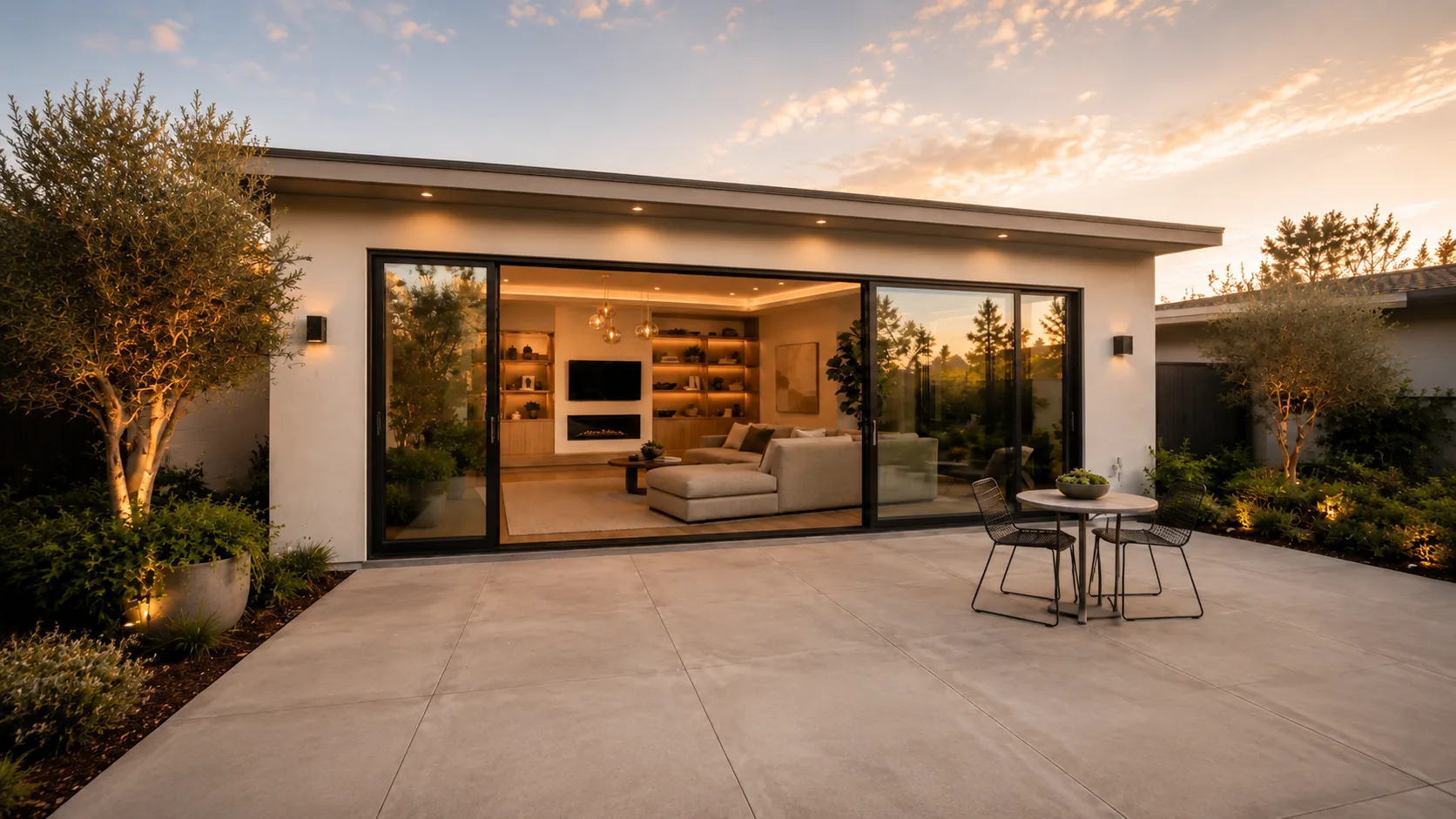
Your Guide to Sliding Door Installation in Orange County
Sliding glass doors are the most common patio door in Orange County homes. This guide covers materials, glass options, track systems, energy compliance, and what homeowners near the coast need to know about durability and corrosion resistance.
If you're researching sliding door installation in Orange County, you're looking at the most common patio door type in the region. The majority of OC tract homes built between the 1970s and the 2000s came with a standard aluminum sliding glass door — and many of those original doors are now overdue for replacement. Whether you're upgrading an aging slider or installing a sliding door in a new or remodeled opening, this guide covers what you need to know about materials, glass options, track systems, costs, and what to expect from the process. When you're ready, you canconnect with a licensed Orange County contractor through our platform.
Standard Sliding Door Configurations
Sliding glass doors come in several configurations. Understanding which is right for your opening helps you have a more productive conversation with your contractor.
- 2-panel (XO or OX): The most common configuration — one fixed panel, one sliding panel. The "X" indicates the sliding panel, "O" is fixed. Available in widths from about 5 to 12 feet. This is the standard replacement for most OC tract homes.
- 3-panel (OXO or XOX): A center sliding panel with fixed panels on each side, or fixed center with two sliding panels. Better for wider openings where you want more glass and a larger opening than a 2-panel provides.
- Pocket sliding door: The sliding panel retracts into a wall pocket, completely out of sight when open. Requires sufficient wall depth for the pocket and is typically a new-construction or major-remodel specification. Costs more than a standard slider but achieves a cleaner look.
If you're considering a system where all or most of the panels move and stack — often called a multi-slide or lift-and-slide door — that's a different product category. Our patio door guide covers the full spectrum from standard sliders to wide-format systems.
Material Options for Orange County Homes
Frame material affects durability, maintenance requirements, energy performance, and cost. All four common sliding door materials perform well in OC's climate, but each has trade-offs worth understanding — especially for homes near the coast.
| Material | Climate & Maintenance | Typical Price Range |
|---|---|---|
| Vinyl | Excellent inland and good on the coast — UV-stable formulations resist fading and warping. Upkeep is very low — wipe clean, no painting, no sealing. | $1,400–$3,500 |
| Aluminum | Excellent — naturally corrosion-resistant, and the standard choice for coastal OC homes. Upkeep is low — occasional cleaning; the powder-coat finish holds up against salt air. | $2,500–$7,000 |
| Fiberglass | Excellent — resists warping, salt air, and UV, with the best thermal performance of the four. Upkeep is low — no refinishing needed; holds paint well if you want color. | $3,000–$10,000+ |
| Wood-Clad | Good — an aluminum or fiberglass exterior protects the wood interior, though the exterior still needs attention. Upkeep is low outside; interior wood may need periodic care. | $4,000–$12,000+ |
For most OC homeowners replacing a standard tract-home slider, vinyl is the practical starting point — it's affordable, energy-efficient, and genuinely low-maintenance. If you're closer to the coast or want a more refined look, aluminum is the upgrade that makes the most sense: it handles salt air well, it's strong enough for larger panel sizes, and it has a cleaner, more contemporary profile than vinyl. Fiberglass is the highest-performing option thermally and the most resistant to the full range of coastal conditions, though it's also the most expensive of the standard frame types.
Glass Options for Orange County Homes
The glass specification matters as much as the frame material — sometimes more. Here's what to know about the main options.
- Dual-pane (insulated glass): The standard for any new sliding door installation in California. Two panes with an air or gas fill between them significantly reduce heat transfer compared to single-pane glass. Required for Title 24 compliance in virtually all OC replacement scenarios.
- Low-E glass: A microscopically thin metallic coating on the glass that reduces solar heat gain (keeping rooms cooler in summer) without reducing visible light. Low-E glass is nearly universal in California-sold doors and is the right choice for south- and west-facing openings where direct sun exposure is high.
- Impact-resistant glass: Laminated glass designed to resist shattering on impact — relevant for coastal OC homes where wind-driven debris is a concern, or for homes where security is a priority. Adds cost but can also qualify for insurance discounts in some cases.
- Tempered glass: Standard safety glass that breaks into small, blunt pieces rather than sharp shards. Required by code in door applications — all sliding doors sold for residential use include tempered glass panels.
Track Systems and Hardware
The track system determines how a sliding door operates day-to-day. Most residential sliding doors use a bottom-rolling system — the panel weight rests on rollers that ride along a bottom track. This is the standard configuration and works well for most applications. Higher-end systems use top-hung tracks, where the panel hangs from an overhead track and the bottom track is purely a guide. Top-hung systems operate more smoothly under heavy panel weights and eliminate the dirt-collection problem of deep bottom tracks — a meaningful advantage for large-format doors.
Hardware quality matters for long-term operation. The rollers and track that come with budget-tier doors are a common source of the sticking and grinding problems that prompt replacement. When replacing an aging slider, specifying a door with quality stainless-steel rollers and an adjustable roller assembly adds a modest amount to the cost and dramatically extends trouble-free operation.
What Sliding Door Installation Costs in Orange County
Costs for residential sliding door installation in OC vary by size, material, and project complexity. Here's a realistic overview:
- Standard 2-panel vinyl or aluminum (existing opening, no structural changes): $1,400–$3,500 all-in
- Mid-range project (quality vinyl or aluminum, some opening adjustment, upgraded glass): $3,500–$7,000
- Higher-end project (fiberglass, wood-clad, large 3-panel, or premium hardware): $6,000–$10,000+
Labor typically runs $500–$1,200 for a straightforward replacement. Permit fees add $100–$400 in most OC cities. Structural modifications — widening the rough opening or replacing a header — can add $1,500–$4,000 depending on the scope. For a city-by-city cost breakdown, see our Orange County door installation cost guide.
Coastal Orange County Considerations
For homes in Huntington Beach, Newport Beach, Corona del Mar, Laguna Beach, Dana Point, and San Clemente, a few additional factors are worth attention. Salt air accelerates corrosion in unprotected metal hardware and lower-quality aluminum frames. Specify marine-grade or anodized aluminum frames, stainless-steel hardware, and ask your contractor about corrosion-resistant track systems if you're within a mile or two of the coast. UV exposure in Southern California fades and degrades lower-quality frame materials faster than in many other climates — this is another argument for specifying UV-stable vinyl or quality aluminum rather than the cheapest available option. Wind-driven rain during coastal storms puts pressure on weatherstripping and seals — make sure your replacement door has a solid weatherstripping specification and that installation includes thorough exterior caulking and sealing.
Energy Efficiency and California Title 24
California's Title 24 energy code sets minimum performance requirements for replacement doors, including U-factor (how well the door insulates) and solar heat gain coefficient (how much solar energy passes through). Most sliding doors sold by major manufacturers — Milgard, Andersen, Pella, JELD-WEN — meet or exceed Title 24 requirements when specified with dual-pane low-E glass, which is standard on virtually all mid-range and higher doors. Your contractor should confirm Title 24 compliance for the specific door and glass combination before purchase. Compliance isn't just a code box to check — low-E glass meaningfully reduces summer heat gain through south- and west-facing glass, which is relevant for most OC homes.
Standard Sliders vs. Multi-Slide Systems
Standard sliding doors and multi-slide (lift-and-slide) systems both operate on tracks, but they're fundamentally different products at different price points. A standard slider gives you one moving panel and one fixed panel — about 50% of the width as the open area. A multi-slide system has multiple large panels that all move and stack or pocket, opening the full width. Entry multi-slide systems for smaller residential openings typically start around $4,000–$8,000; wide-format configurations commonly run $12,000–$30,000+, with larger custom or pocket systems higher. They're the right choice for indoor-outdoor living projects where the goal is to eliminate the distinction between inside and outside — but they're not a sliding door replacement; they're a room transformation. If that's the direction you're considering, our patio door guideprovides a full comparison alongside bi-fold alternatives.
Get matched with a trusted contractor today
We connect Orange County homeowners with one experienced, licensed contractor — rather than a pool of competing bids. Your project deserves full attention — from design and door selection through ordering and installation.
- Typically matched to one contractor — not circulated to a pool of competing bidders
- All contractors licensed, bonded & insured in California
- You'll hear back quickly — usually within one business day
- 100% free — no obligation, no pressure
What best describes your project?
This helps us match you with the right contractor.
What type of doors are you interested in?
Select all that apply.
Prices reflect Orange County averages. Custom or high-end installations may exceed these ranges. Your contractor will provide a detailed quote. Estimates include the door and professional installation. Your contractor can help you choose the right door for your home and budget.
When are you looking to get started?
No pressure — this just helps us prioritize.
Tell us a little about yourself
Your contractor will reach out to discuss your project.
Have photos of your current doors or space?
Tap to upload (JPG or PNG)
You’re all set!
Your matched contractor will reach out to discuss your project. Your information has not been shared with anyone else.