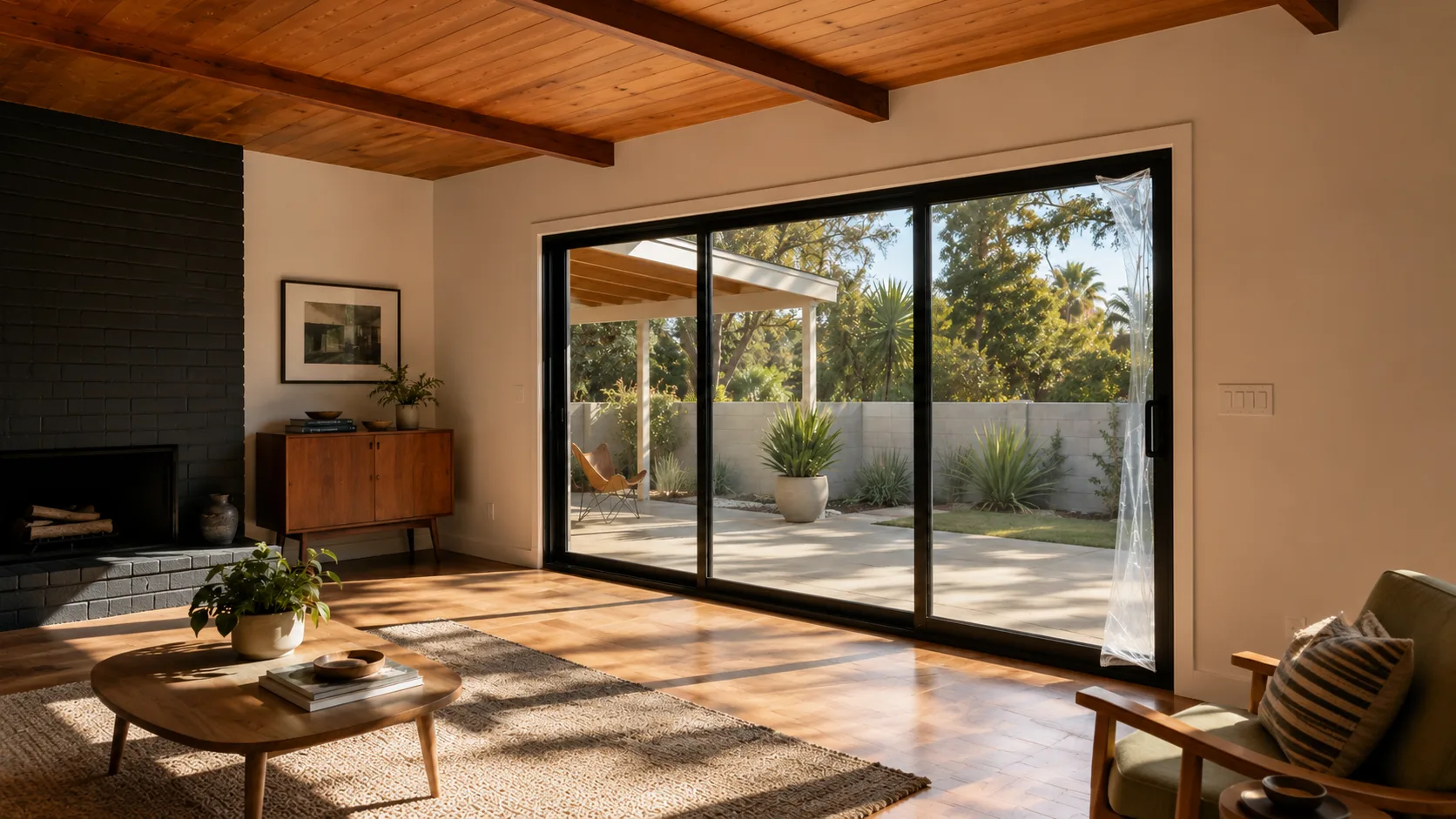
Your Guide to Door Replacement in Orange County
Replacing existing patio or exterior doors is one of the most impactful upgrades Orange County homeowners make. This guide covers how to know when it's time, what the replacement process involves, and how to approach it as an energy, security, and value upgrade.
If you're researching door replacement in Orange County, you're probably dealing with a door that's past its useful life — drafty, foggy, difficult to operate, or just outdated. Door replacement is distinct from new installation: you're working with an existing opening, an existing structural frame, and often a home that reflects the building standards of the 1970s, 80s, or 90s. This guide is written specifically for that scenario. It covers how to recognize when replacement is the right call, what the process involves, what it costs by door type, and how to approach it as an energy, security, and value upgrade rather than just a repair. When you're ready, connect with a licensed Orange County contractor through our platform.
Signs It's Time to Replace Your Patio Doors
Most Orange County homeowners don't replace doors on a schedule — they replace them when the signs become hard to ignore. Here's what to look for:
- Drafts and air infiltration: If you can feel air movement around a closed door — around the frame edges, at the bottom threshold, or through the lock mechanism — the weatherstripping has failed. While weatherstripping can sometimes be replaced on its own, it's often a sign that the door frame itself has shifted or degraded and that a full replacement will be more cost-effective than ongoing repairs.
- Condensation or fog between glass panes: Fogged or hazy glass is a failed insulated glass seal — moisture has entered the space between the panes. This cannot be repaired without replacing the glass unit or the entire door. Once a seal fails, the insulating value of the glass is significantly reduced.
- Difficult or sticky operation: A sliding door that grinds, lifts off track, or requires significant force to move; French doors that bind, sag, or don't latch properly. These are symptoms of worn hardware, a settling frame, or a warped door — problems that compound over time and rarely resolve without intervention.
- Visible frame damage: Warping, cracking, or deformation in wood frames; corrosion in aluminum frames; water staining or soft spots that suggest moisture intrusion behind the frame. Any visible damage to the structural integrity of the door frame warrants a closer look.
- Rising energy bills: Single-pane glass — common on original aluminum sliders in OC homes built before the mid-1990s — is a significant source of heat gain and loss. If your energy bills have been climbing and your doors still have original glass, replacement can yield measurable efficiency improvement.
- Security concerns: Original lock hardware on 1970s–1990s sliding doors is often inadequate by modern standards. While hardware can be upgraded independently, a door whose frame has shifted or whose track is worn may not hold a lock reliably.
- Outdated aesthetics: This is more subjective, but it matters — especially in an OC real estate market where buyers respond to updated, contemporary finishes. Original bronze-tone aluminum sliders read as dated in a way that affects perceived home value.
If you're seeing two or more of the above, replacement is typically more cost-effective than continued repair. The cumulative cost of multiple repair visits often approaches or exceeds the cost of a straightforward replacement — and replacement gives you a fresh 20+ year product life, not an extended maintenance cycle.
Framing Replacement as an Upgrade
The most useful way to think about door replacement is not as a repair — it's as an investment with measurable returns across several dimensions:
- Energy efficiency: Replacing a single-pane original aluminum slider with a modern dual-pane low-E door can reduce solar heat gain through that opening by 40–60%, depending on orientation. On a south- or west-facing opening in OC's sunny climate, that's a real reduction in cooling load during summer months.
- Security: Modern multi-point locking systems, tempered laminated glass, and reinforced frames represent a meaningful security upgrade over 30-year-old hardware.
- Home value: Updated patio doors — particularly French door or sliding door upgrades — are consistently cited as high-return improvements in home valuations. Buyers in the OC market notice and respond to updated doors, especially in the mid-to-upper price brackets.
- Comfort: Eliminating drafts, reducing noise transmission, and cutting summer heat gain through glass all improve day-to-day comfort in ways that are immediately noticeable.
Orange County-Specific Context
Orange County's housing stock creates some specific replacement scenarios worth understanding. Tract homes built from the 1970s through the 1990s — common across Irvine, Anaheim, Fullerton, Santa Ana, and many other OC cities — typically came with standard aluminum sliding glass doors, single or early dual-pane glass, and relatively narrow opening widths (6–8 feet). These homes are well into the age range where original doors are due for replacement, and upgrading to a modern sliding door with a quality frame and dual-pane low-E glass is a straightforward, high-value project.
Coastal OC homes — in Huntington Beach, Newport Beach, Laguna Beach, Dana Point, and other beach cities — face the additional challenge of salt air corrosion. Original aluminum frames in coastal properties often show corrosion on the hardware, track, and frame surfaces. When replacing, specify corrosion-resistant frames (marine-grade or anodized aluminum, or fiberglass) and stainless-steel hardware. A door specified for interior OC conditions may not hold up as well at a home two blocks from the beach.
The Door Replacement Process
Understanding what's involved helps you plan around the work and ask better questions when getting quotes.
- Assessment: A qualified contractor evaluates the existing door, rough opening, and framing condition. This is where they identify whether the rough opening needs modification, whether the header is adequate, and what finishing work will be required.
- Measurement and ordering: The contractor measures the rough opening precisely and orders the replacement door. Stock sizes (standard 6-foot and 8-foot sliding doors, standard French door sizes) can often be sourced quickly. Custom or specialty sizes take longer — 3–8 weeks for made-to-order units.
- Permit: Whether a permit is needed depends on your city and the scope of the project. If one is required, the contractor pulls it from your city's building department, and processing time varies by city.
- Removal: The existing door, frame, and surrounding trim are removed. The contractor inspects the rough opening for rot, moisture damage, or framing issues that weren't visible before removal — and addresses them before the new door goes in.
- Installation: The new door unit is set in the rough opening, shimmed level and plumb, and secured to the framing. This step determines whether the door will operate correctly for its lifetime — a poorly set door will never seal or operate properly.
- Seal and finish: Weatherstripping, threshold, interior and exterior trim, and caulking are installed. Proper sealing at this stage is essential for energy performance and water intrusion prevention.
- Inspection: For permitted work, a city inspector reviews the installation before sign-off. This closes the permit and confirms the work meets code.
Replacement Cost Ranges by Door Type
Door replacement costs in Orange County vary by door type, material, and whether structural work is required. Here's a realistic summary:
| Door Type | Typical Installed Range | Notes |
|---|---|---|
| Sliding Door | $1,400–$10,000+ | Standard 2-panel: $1,400–$3,500. Larger or premium systems reach $4,000–$10,000+. |
| French Doors | $2,200–$12,000+ | Standard double door: $2,200–$4,800. High-end materials or framing changes: $5,000–$12,000+. |
| Bi-Fold Doors | $2,500–$18,000+ | Smaller 3–4 panel systems: $2,500–$5,500. Wider patio configurations: $7,000–$18,000+ (large custom spans can run higher). |
Add any permit fees (set by each city) and structural modifications if the opening size is changing ($1,500–$5,000 depending on scope). Labor for a straightforward same-size replacement typically runs $500–$1,200. For a detailed breakdown with city-specific notes, see our Orange County door installation cost guide. For more detail on specific door types, our French door guide and sliding door guide cover materials and costs in depth.
Permits for Door Replacement in Orange County
Whether a replacement door needs a permit depends on your city and the scope of the project. Many Orange County cities treat a like-for-like swap in the same opening differently from a project that changes the opening, framing, or door type, and some require a permit for any exterior door replacement. Where a permit applies, the process ensures the installation meets California Building Code requirements for structural integrity, energy performance (Title 24), and weatherproofing. Your contractor can confirm requirements with your city's building department before work begins and will pull the permit on your behalf as part of the project scope; you should not be asked to pull your own permit, and a contractor who suggests skipping a required permit is worth being cautious about.
Permit fees and processing times are set by each city, and some cities offer over-the-counter approval for standard same-size replacements. If you're in an HOA community, architectural committee approval may also be required before work begins — our HOA door replacement guide walks through that process. Unpermitted work can create complications when you sell your home, void manufacturer warranties, and create liability if something goes wrong during installation. The permit process is a meaningful protection for you as a homeowner — not just a bureaucratic step.
Get matched with a trusted contractor today
We connect homeowners with one experienced contractor, not a pool of competing bids. Your project gets full attention, from design and door selection through ordering and installation.
- Matched with one contractor, not circulated to a pool of competing bidders
- Before matching, we check each contractor's license (where the state requires one), insurance and reviews.
- We'll follow up within 2 business days.
- 100% free: no obligation, no pressure
What best describes your project?
This helps us find the right contractor for your project.
What type of doors are you interested in?
Select all that apply.
Prices include the door and professional installation. Custom or high-end installations may exceed these ranges.
Prices cover the door and professional installation. Creating or enlarging the opening is extra, and a contractor prices it after a site visit.
new-opening prices include a standard opening. Load-bearing walls and larger openings cost more.
"+ opening" means the price covers the door and installation, and a contractor prices the opening work after a site visit. Wide openings usually need a structural beam and engineering.
Prices reflect Orange County averages. A contractor confirms exact pricing after discussing your project with you and can help you choose the right door for your home and budget.
When are you looking to get started?
No pressure. This just helps us prioritize.
Anything else we should know?
Have photos of your current doors or space?
Tap to add photos.
Last step: your contact information
We'll review your request and follow up within 2 business days.
Used to contact you about this request.
You’re all set!
Thank you. We'll review your project and follow up within 2 business days to connect you with an experienced contractor. Your information has not been shared with anyone else.