Indoor-Outdoor Living Orange County
How Orange County homeowners are dissolving the wall between inside and outside — and the door systems that make it possible.
Where Inside Ends and Outside Begins
Orange County's climate is among the most accommodating in the country — roughly 280 days of sunshine, mild winters, and evenings that rarely require a jacket even in January. It's not surprising that OC homeowners have embraced indoor-outdoor living more fully than almost anywhere else in California. The question isn't whether to connect your home to the outdoors. It's how to do it well.
What's changed in the last decade isn't the climate or the culture — it's the door technology. The systems available today for connecting interior living spaces to patios, gardens, and outdoor dining areas are dramatically more capable than the standard sliding door that ships with most OC tract homes. Folding glass walls, flush-threshold systems, and wide-format multi-slide doors have moved from architectural showrooms into mainstream renovation budgets. And once you've stood in a room where the wall literally disappears — where the kitchen becomes the patio and the living room extends to the pool deck — a standard slider feels like a missed opportunity.
This guide covers the door systems that make true indoor-outdoor living possible, what to think about when designing for that transition, and the practical OC-specific factors that affect how these projects actually get built.
Four Door Types, Four Ways to Open Up
Not every door type is suited to every indoor-outdoor project. The right system depends on the opening width, the architectural character of the home, your budget, and how complete you want the indoor-outdoor connection to feel.
French Doors
The classic. A pair of hinged glass-panel doors opening onto a porch, courtyard, or garden brings immediate warmth and architectural presence. French doors don't disappear — they frame the view. That's part of their appeal. They're best suited to openings up to about eight feet wide, and they reward traditional and transitional home styles that define so much of OC's housing stock. Learn about French door installation in Orange County.
Sliding Patio Doors
The practical workhorse. Sliding doors are the most common patio door in OC homes and for good reason — they're affordable, low-maintenance, and available in sizes that fit most existing openings. A quality sliding door with a low-profile track and good weatherstripping is a real upgrade over an aging aluminum slider. The limitation is aperture: in a two-panel configuration, you get 50% of the span as open air. That's enough for most situations, but it's not a disappearing wall. Compare sliding and other patio door options.
Bi-Fold Doors
The transformation. Bi-fold panels fold accordion-style and stack to one or both sides of the opening, turning a wall into a threshold. An eight-foot opening becomes eight feet of open air. A twelve-footer becomes a twelve-foot invitation to step outside. The folded stack of panels remains at the edge, but the visual and physical effect is dramatic. These are the doors you see in OC's indoor-outdoor showcase homes — and they're increasingly accessible at mid-range budgets. See our bi-fold door guide for OC homeowners.
Multi-Slide & Disappearing Wall Systems
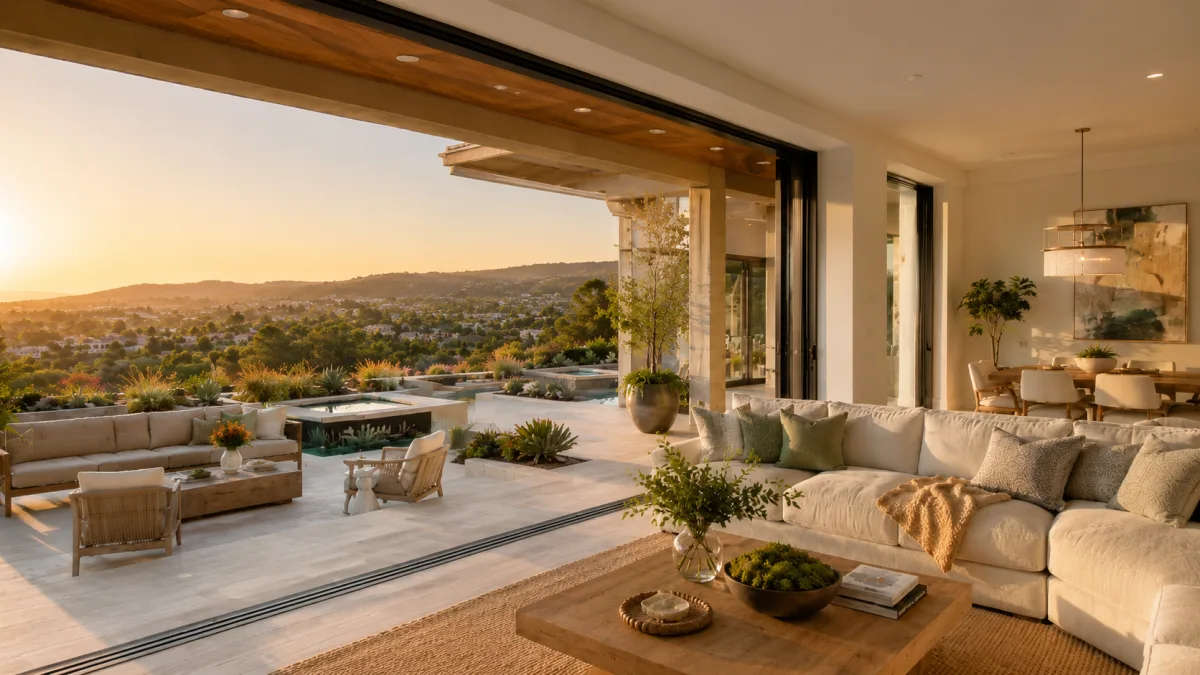
The statement. Multi-slide systems — sometimes called lift-and-slide or panoramic doors — use wide panels that slide and pocket entirely into the wall cavity, achieving a true floor-to-ceiling glass wall effect. When open, there's nothing: no stacked panels at the edge, no threshold to step over, just the living room merging with the outdoor space. These are the highest-investment systems, typically beginning at $10,000 and reaching $40,000+ for larger custom installations. They require wall depth for the pocket and structural engineering for wide spans — but for the right project, they're transformative in a way nothing else matches. See our multi-slide door guide for OC homeowners.
What Makes Indoor-Outdoor Living Actually Work
The door is the hinge point — but the indoor-outdoor experience is shaped by the design decisions surrounding it. A beautiful bi-fold system installed into a poorly planned transition will underperform. These are the elements that the best indoor-outdoor renovations get right.
Sightlines
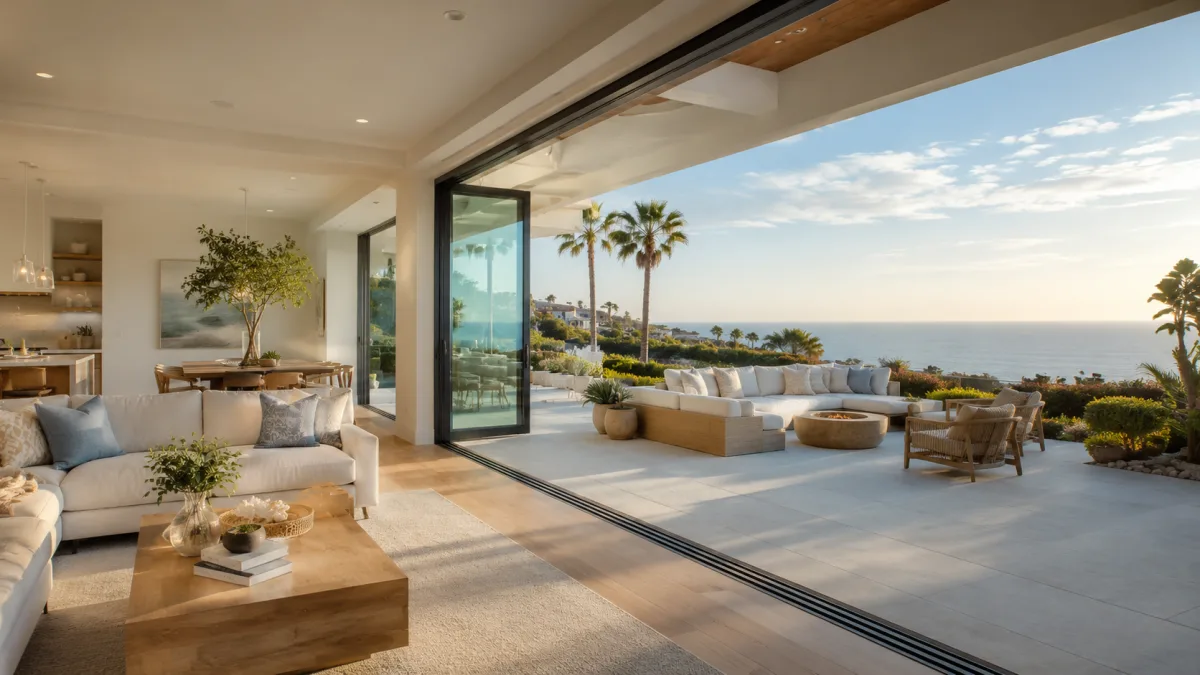
The goal is an unobstructed view from the interior to the exterior — ideally with the eye traveling past the door and landing on a focal point beyond: a garden, a water feature, a mountain view, the ocean. This means thinking carefully about the door's position relative to your interior layout, and about what the door frames when it's closed. Thinner frame profiles (aluminum systems typically outperform vinyl here) maximize the glass area and minimize visual interruption.
Floor-Level Thresholds
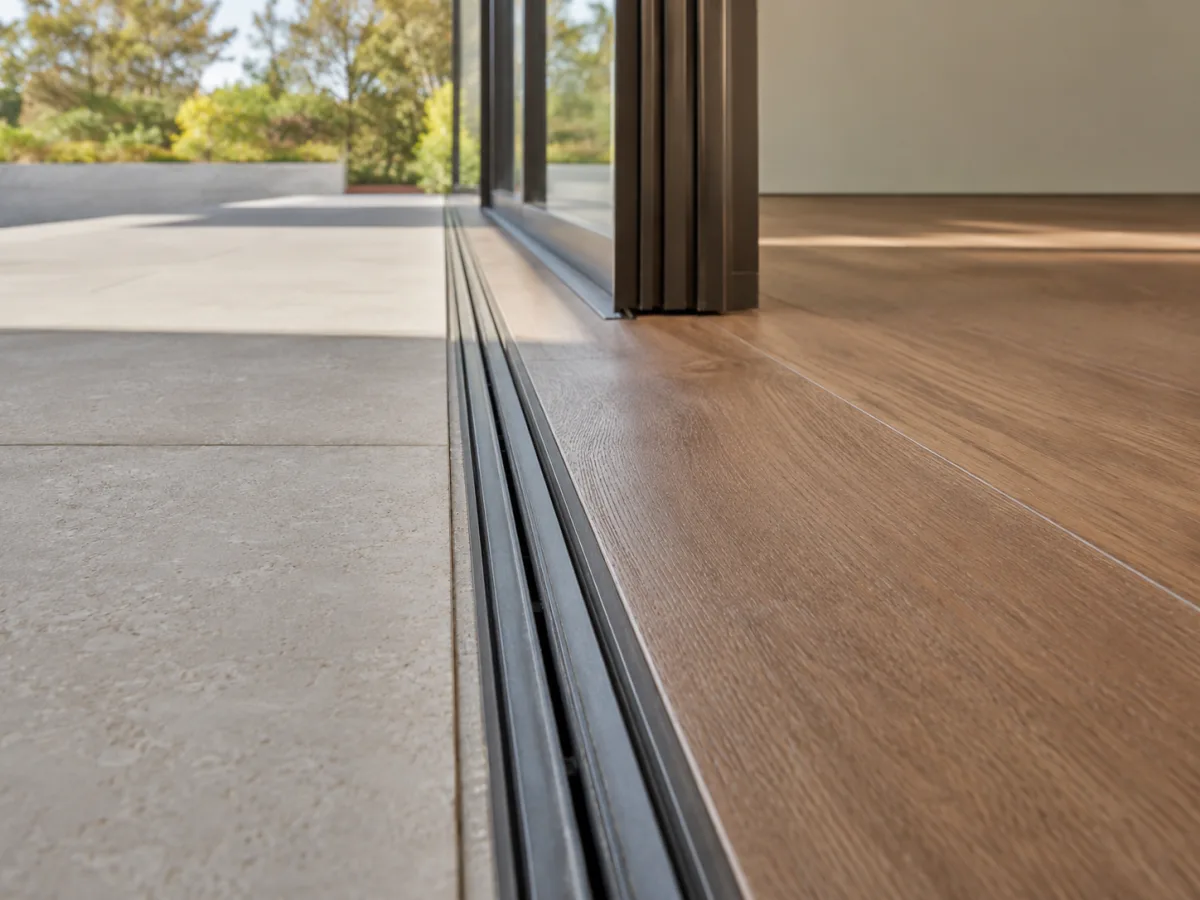
One of the most overlooked design decisions in indoor-outdoor projects is the threshold condition. Standard door systems have a raised sill that creates a step — a physical and psychological interruption to the flow. Flush or near-flush threshold systems eliminate that step, so you walk from interior to exterior without breaking stride. This requires careful planning around drainage, waterproofing, and finished floor heights, but when executed well, it's one of the most impactful details in the entire project.
Flooring Continuity
When interior and exterior flooring share the same material — large-format porcelain tile that runs from the living room through to the patio, or a wood finish that transitions to matching composite decking — the two spaces read as one. This isn't just visual: it changes how you use the space. Guests flow between inside and outside without the conscious decision to "go outside." The flooring becomes part of the architecture rather than a boundary between two different rooms.
Furniture Flow and Space Planning
Indoor-outdoor living works best when the furniture arrangement supports movement between spaces rather than treating the exterior as a separate destination. An outdoor sofa positioned to face the interior, rather than turned away from it. A dining table that anchors both sides of the threshold. Lighting at matching heights so neither space dominates visually after dark. These choices are often made after the door is installed — but the best projects plan for them before the contractor shows up.
Lighting Transitions
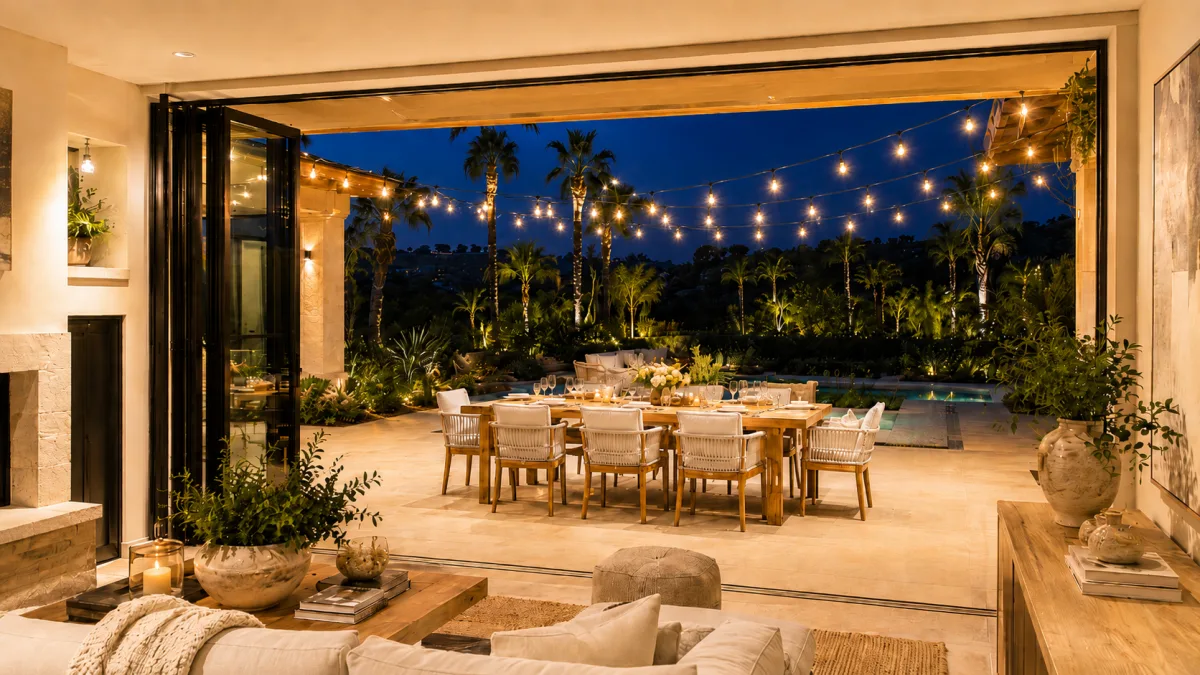
Interior lighting is typically warmer and more controlled than the natural light of a Southern California afternoon. At dusk, without deliberate planning, the interior can feel like a lit box viewed from the dark exterior — or the patio can feel dim and underlit by comparison. Thoughtful lighting design — cove lighting that extends to the eave, string lights or pendant fixtures that continue the interior's warmth outdoors, landscape lighting that draws the eye deeper into the garden — bridges that gap and makes the space feel intentionally designed.
Climate, Exposure, and Practical Considerations
Indoor-outdoor living in Orange County isn't one thing — it plays out differently depending on where you are and what your site conditions look like. Here's what shapes the practical side of these projects across OC.
Coastal vs. Inland Climate
If your home is within a few miles of the coast — Newport Beach, Laguna Beach, Dana Point, Huntington Beach — salt air is a real material consideration. Aluminum frames and fiberglass door systems hold up significantly better than vinyl in salt-air environments. Stainless hardware and marine-grade finishes extend the life of the installation. Inland, where salt air isn't a factor (Irvine, Anaheim Hills, Mission Viejo, the canyon communities), vinyl systems are a solid value option and perform well in the drier heat. Your door selection should match the exposure, not just the aesthetic. Our OC city guides include climate-specific material notes for each community.
Covered Patio vs. Open Exposure
A covered patio — whether a pergola, solid patio cover, or deep eave overhang — dramatically changes the livability of the indoor-outdoor transition and affects which door systems are most appropriate. Covered areas allow for lower-threshold systems with lighter weatherstripping requirements; fully exposed patios face direct rain exposure and wind-driven water, requiring more robust sealing and drainage planning. If you're designing a new indoor-outdoor living space rather than upgrading an existing one, the patio cover decision is closely tied to the door system decision — plan them together.
Bug Screens and Ventilation
One of the practical trade-offs with folding and multi-slide door systems is screening. Standard retractable screens are available for most bi-fold systems; some manufacturers offer integrated retractable screens that disappear into the door frame when not in use. This matters more in the warmer inland OC communities than along the coast, where evening breezes are one of the primary pleasures of having the doors open. Ask your contractor about screen options before committing to a door system — it's easier to plan for them upfront than to retrofit later.
How Indoor-Outdoor Living Affects OC Home Value
Orange County's real estate market is one where lifestyle features — not just square footage — drive purchase decisions. Indoor-outdoor flow is consistently cited by buyers and agents as a top differentiator in the mid-to-upper price tiers, and the data supports treating it as a serious investment rather than a purely aesthetic choice.
A well-executed indoor-outdoor renovation — quality door system, flush or low-profile threshold, coordinated exterior finishes — adds value beyond the direct cost of the doors. The multiplier effect comes from how the improvement integrates with the outdoor living space as a whole: a bi-fold door opening onto a finished, furnished patio with good lighting and landscaping returns more than the same door installed into an unimproved yard. OC buyers are evaluating the complete picture.
Specific ROI figures are difficult to pin down because they depend heavily on the home's neighborhood, price point, and the quality of the overall execution. What's consistent across OC markets is that indoor-outdoor improvements shorten time on market and support stronger pricing compared to otherwise similar homes that lack the connection. For homeowners planning to sell within five to ten years, it's one of the higher-return exterior investments available. For homeowners who intend to stay, the quality of life benefit is reason enough.
If you're ready to start planning your project, our door installation cost guide covers realistic budget ranges by door type and scope — a useful starting point before you talk to a contractor. When you're ready, connect with an experienced OC installer through our platform.