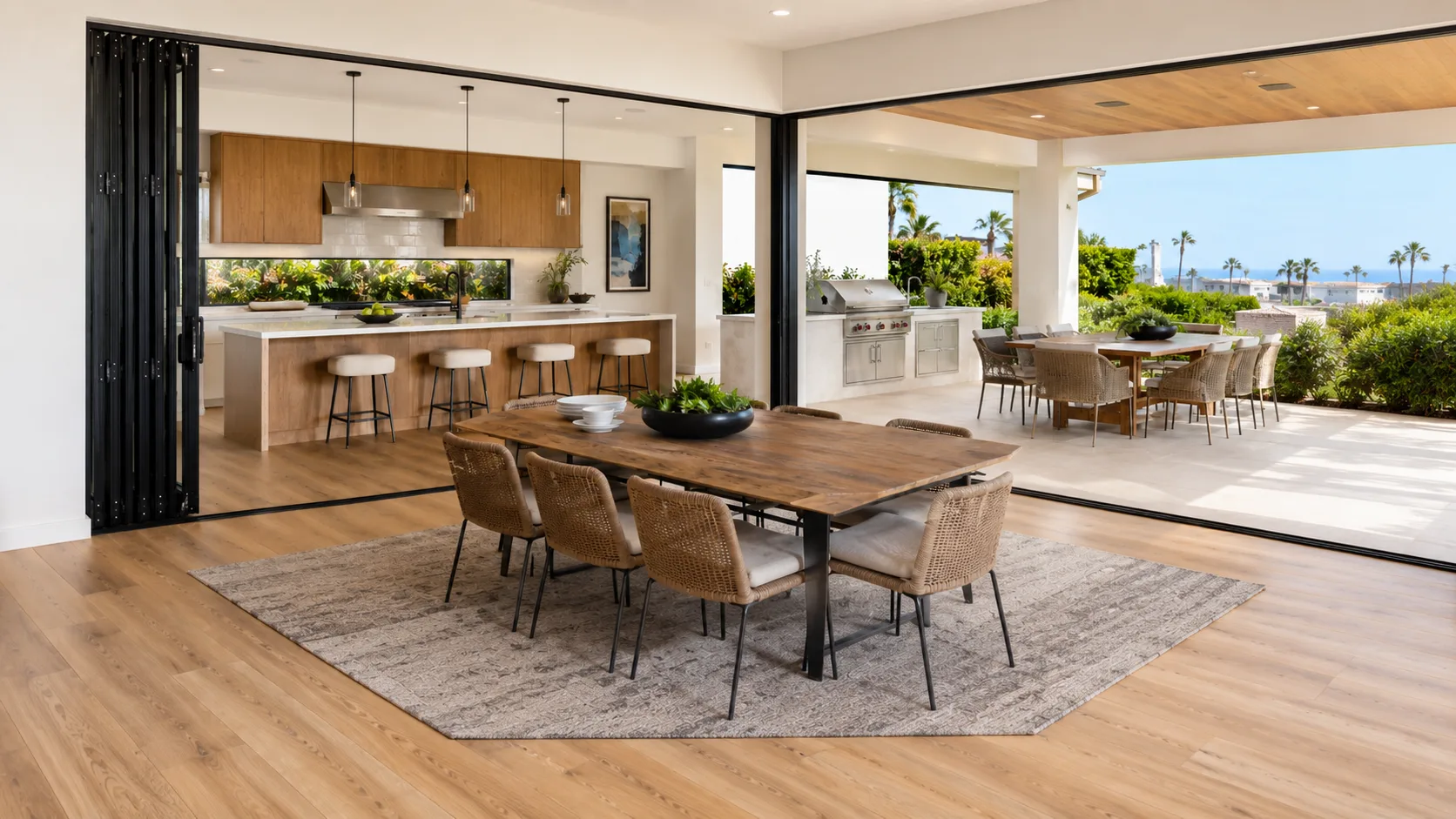
Your Guide to Bi-Fold Door Installation in Orange County
Bi-fold doors create the seamless indoor-outdoor connection that defines Orange County's high-end outdoor living aesthetic. This guide covers configurations, materials, structural requirements, leading brands, and realistic costs for OC homeowners.
If you're researching bi-fold door installation in Orange County, you're likely thinking about one of the most transformative upgrades an OC homeowner can make. Bi-fold doors — sometimes called folding glass doors or accordion doors — are the system that turns a wall into an opening, creating a seamless connection between indoor living space and an outdoor patio, deck, or yard. They're the signature feature in high-end Newport Beach, Laguna Beach, and Coto de Caza homes, but they're increasingly common in more modest remodels across the county. This guide covers how they work, what they cost, what structural realities to plan for, and which brands are available locally. When you're ready to connect with an installer, request a quote through our platform.
How Bi-Fold Doors Work
Bi-fold doors use a series of panels hinged together at their vertical edges. When opened, the panels fold accordion-style and stack against one or both sides of the opening — depending on whether the configuration is "single stack" (all panels to one side) or "split" (panels stack to both sides). A top-hung track carries the panel weight; a bottom guide track keeps the panels aligned.
Panel counts typically range from 2 to 10 or more panels, depending on the opening width. Most residential OC projects use 3–6 panels for openings in the 10–20-foot range. The individual panel width is usually 18–36 inches — narrower panels are required for taller door heights to maintain structural integrity. A 16-foot opening, for example, might use four 4-foot panels or five 3.2-foot panels.
When fully open, bi-fold doors expose 85–95% of the total opening width. A small area at the panel stack remains inaccessible, unlike a multi-slide pocket system where panels disappear into the wall entirely — but for most homeowners, the difference is not practically meaningful.
Threshold and ADA Considerations
The threshold — the transition between the interior floor and the exterior — is one of the most important decisions in bi-fold door specification, and it's often underestimated. Options include:
- Standard threshold: A raised weather barrier at the base of the door. Effective weatherseal, lowest cost, but creates a step that some occupants find inconvenient.
- Flush threshold: The interior floor and exterior deck or patio are at the same level, with a low-profile threshold strip between them. Creates the seamless indoor-outdoor flow that most homeowners are after. Requires planning during the design phase — the floor and outdoor surface levels must be coordinated.
- Recessed or ADA-compliant threshold: A flush or near-flush transition specifically designed to be compliant with accessibility requirements. Some OC homeowners in communities with universal design requirements or aging-in-place goals specify this option.
Flush thresholds require adequate weatherproofing to prevent water intrusion — particularly relevant in OC's occasional heavy rain events and for any coastal-area homes. Discuss threshold options with your contractor early; retrofitting a threshold configuration after installation is expensive.
Materials
Bi-fold door frame materials narrow quickly in practice. Wood and wood-clad systems exist but are relatively uncommon for OC exterior bi-fold applications. The dominant material in the market — particularly for the wide-span, high-performance systems most OC homeowners are looking at — is aluminum.
| Material | Climate & Maintenance | Typical Price Range |
|---|---|---|
| Aluminum | Excellent — naturally corrosion-resistant, and handles coastal conditions and UV well. Upkeep is low — the powder-coat finish is durable; clean the tracks periodically. | $2,500–$18,000+ |
| Wood | Moderate — a beautiful interior, but exterior wood needs regular maintenance in OC's coastal humidity. Upkeep is high — periodic refinishing, sealing, and inspection. | $7,000–$25,000+ |
| Aluminum-Clad Wood | Good — the aluminum exterior protects the wood interior, giving better coastal performance than all-wood. Upkeep is low outside; interior wood may need occasional care. | $10,000–$30,000+ |
For most OC bi-fold door projects, thermally broken aluminum is the practical and aesthetic standard. A thermal break is a non-conductive material inserted into the aluminum frame profile to interrupt heat transfer — without it, aluminum frames conduct significant heat from outside to inside (or vice versa), undermining the energy efficiency of the glass. Quality bi-fold door systems — La Cantina, NanaWall, Western Window Systems — include thermal breaks as standard. Specify it if you're evaluating multiple bids.
What Bi-Fold Doors Cost in Orange County
Bi-fold door costs have a wide range because the systems themselves vary widely in size, panel count, specification, and brand. Here's a realistic overview for OC residential projects:
- Smaller residential systems (3–4 panels, stock or near-stock opening):$2,500–$5,500 installed
- Wider patio systems (more panels, 12–18 ft wide, quality aluminum with thermal break): $7,000–$18,000 installed
- Large custom spans (6–8+ panels, 18–24+ ft wide, or premium brand):$18,000–$30,000+ installed
These ranges are for the door system and installation labor. Structural modifications — header replacement or addition — typically add $1,500–$5,000 depending on scope. Permits add $150–$500 in most OC cities. For a broader cost context, see our Orange County door installation cost guide. Homeowners reporting costs at the low end typically have existing structural openings with adequate headers and minimal finishing work; those at the high end are commonly opening up new spans or specifying premium brand systems.
Structural Requirements
This is the aspect of bi-fold door projects that most often surprises homeowners. Wide openings require structural support. The wall above a door opening carries load from the roof and floors above — and as that opening gets wider, the structural header spanning it must be proportionally larger and stronger. In many OC homes — particularly tract homes built in the 1970s through 1990s — the existing headers above patio openings were sized for the original door, not for a 16-foot bi-fold span.
In practice, this means your contractor will need to assess the framing before quoting a final price. If the header needs to be replaced or upgraded — and for most new bi-fold installations, it does — the work involves opening the wall, removing the existing header, installing a correctly sized engineered beam, closing the wall, and refinishing the interior and exterior. This is real structural work, and it should be reflected in the scope and budget of your project. Be cautious of bids that don't account for structural assessment or include a suspiciously low allowance for framing work.
For any structural modification, your contractor should pull the appropriate permits, and the work may require an engineer's stamp. This is standard practice — not a red flag — and a good contractor will handle it as part of the project scope.
Leading Bi-Fold Door Brands in Orange County
Several well-regarded manufacturers serve the OC market. Your contractor will typically have relationships with one or two brands they work with regularly — which affects lead times, familiarity with installation, and warranty support.
- La Cantina Doors — Based in San Marcos, California (about 60 miles south of Irvine), La Cantina is one of the most recognized bi-fold and multi-slide door brands in Southern California. Their proximity means shorter lead times than imported systems and access to local technical support. Their products range from accessible entry-level systems to high-specification custom configurations.
- NanaWall — A Swiss-engineered system widely regarded as a benchmark for folding glass wall quality and engineering. NanaWall systems are available through OC-area dealers and specified on high-end residential and commercial projects. Higher cost than most alternatives, but the build quality and engineering are exceptional.
- Western Window Systems — Based in Phoenix, Western Window Systems produces aluminum bi-fold and multi-slide doors popular in contemporary California and Southwest architecture. Good availability through the OC contractor network.
- Milgard — Better known for windows and standard patio doors, Milgard also produces folding door systems that are widely available through OC dealers. A reasonable option for homeowners who want a mainstream brand with local warranty support.
Where Bi-Fold Doors Shine in Orange County
Bi-fold doors are at their best when a homeowner is genuinely trying to dissolve the boundary between interior and exterior — not just add a door, but transform how a room connects to outdoor space. In Orange County, this is most common in coastal communities where the outdoor living season is effectively year-round: Newport Beach homes with courtyard or bay-facing great rooms; Laguna Beach properties on terraced lots where an indoor-outdoor kitchen connection defines the living experience; Coto de Caza and Dove Canyon homes where a great room connects to a pool-and-entertainment outdoor space.
It's also increasingly common in mid-market OC remodels where homeowners are investing in the back of the house — kitchen expansions, great room opens, and California room additions — where a bi-fold door system serves as the architectural centerpiece of the project. If this describes your project, our patio door guide provides additional context for comparing bi-fold against multi-slide options for your specific opening size and goals.
Energy Performance in Southern California
A bi-fold door system that performs well thermally in Southern California needs three things: thermally broken frames (non-conductive insert in the aluminum profile), dual-pane low-E glass (reduces solar heat gain and UV transmission), and compression weatherstripping that seals tightly when the panels are latched closed. These features allow a well-specified bi-fold door to meet California's Title 24 energy code requirements and to perform comfortably year-round. OC's mild winters mean the system won't be under the thermal stress it would face in colder climates, but summer sun exposure — especially on south- and west-facing openings — makes low-E glass worth specifying regardless of code requirements.
Get matched with a trusted contractor today
We connect Orange County homeowners with one experienced, licensed contractor — rather than a pool of competing bids. Your project deserves full attention — from design and door selection through ordering and installation.
- Typically matched to one contractor — not circulated to a pool of competing bidders
- All contractors licensed, bonded & insured in California
- You'll hear back quickly — usually within one business day
- 100% free — no obligation, no pressure
What best describes your project?
This helps us match you with the right contractor.
What type of doors are you interested in?
Select all that apply.
Prices reflect Orange County averages. Custom or high-end installations may exceed these ranges. Your contractor will provide a detailed quote. Estimates include the door and professional installation. Your contractor can help you choose the right door for your home and budget.
When are you looking to get started?
No pressure — this just helps us prioritize.
Tell us a little about yourself
Your contractor will reach out to discuss your project.
Have photos of your current doors or space?
Tap to upload (JPG or PNG)
You’re all set!
Your matched contractor will reach out to discuss your project. Your information has not been shared with anyone else.