Your Guide to Multi-Slide Door Installation Orange County
Multi-slide doors create true disappearing walls — transforming a fixed wall into a floor-to-ceiling glass opening for seamless indoor-outdoor living. This guide covers panel configurations, stacking vs. pocketing systems, structural requirements, and realistic costs for Orange County homeowners.
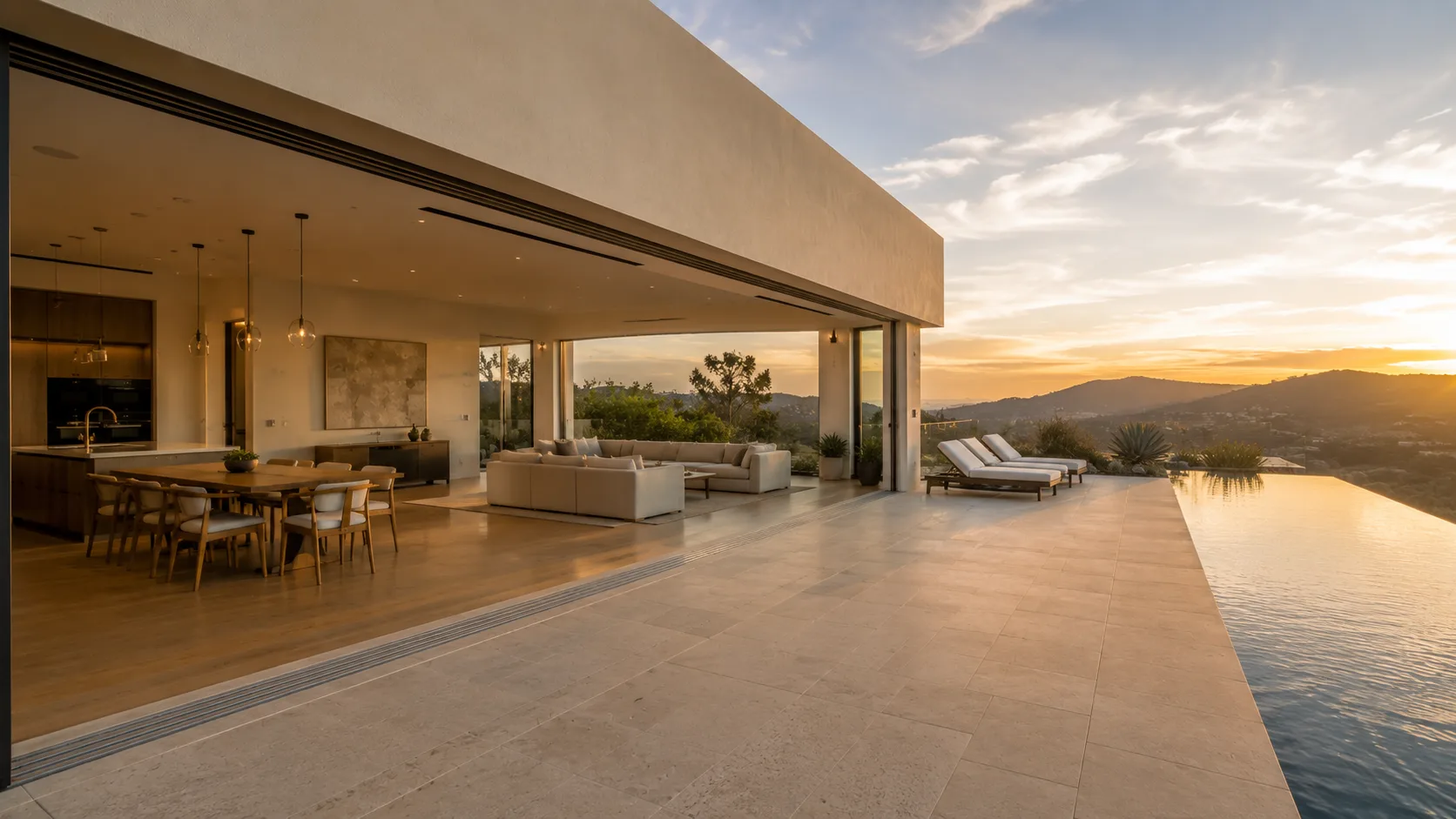
If you're researching multi-slide door installation in Orange County, you're looking at one of the most transformative — and most significant — home investments available. Multi-slide door systems are the category that turns a wall into an opening: multiple large glass panels that slide along a track and either stack neatly behind a fixed panel or pocket entirely into the wall, creating a true floor-to-ceiling glass wall. These are the systems you see in high-end Newport Beach great rooms and Laguna Beach indoor-outdoor kitchens — and they're increasingly specified in OC remodels across the price spectrum. This guide covers how these systems work, what they cost, and what structural realities to plan for. When you're ready, you canconnect with a licensed Orange County contractor through our platform.
What Sets Multi-Slide Doors Apart
A standard sliding door opens 50% of its span — one panel slides, one stays fixed. A bi-fold door opens 85–95%, with panels folding accordion-style and stacking visibly at the edge of the opening. A multi-slide door opens the entire span. Every panel moves, and when the system is fully open, the result is an uninterrupted glass wall — the indoor and outdoor spaces merge without a visible boundary.
This is what distinguishes multi-slide systems from every other door category. They're not just a wider sliding door. The panels are larger, heavier, and engineered to move precisely on reinforced track systems. The hardware, weatherstripping, and locking mechanisms are designed for high-cycle use on large-format panels. And the structural requirements — particularly for wider spans — are meaningfully more involved than a standard door replacement. These are the systems that define the indoor-outdoor living aesthetic that Southern California is known for, and they're priced accordingly.
Panel Configurations — 2-Panel to 12+ Panel Systems
Multi-slide systems are available in panel counts from 2 to 12 or more, depending on the opening width and manufacturer. Most OC residential projects use 3–6 panels for openings in the 12–24-foot range. Individual panel widths typically fall between 24 and 36 inches — narrower panels are required for taller door heights to maintain structural integrity.
Configuration options include:
- Single-stack: All panels slide and stack to one side of the opening. Requires adequate wall space on the stacking side to receive all panels.
- Split (center-open): Panels split and stack to both sides, opening from the center. Creates a symmetrical look and distributes the stack depth evenly on each side.
- Pocket: Panels slide into a wall cavity rather than stacking visibly. All panels disappear when open. Requires wall depth to accommodate the panel pocket — more on this below.
Panel count and configuration should be determined during the design phase, since both affect structural requirements, track placement, and wall framing on either side of the opening.
Stacking vs. Pocketing — Two Ways to Open the Wall
The distinction between stacking and pocketing systems is one of the most important decisions in specifying a multi-slide door.
Stacking systems slide open and stack the panels against the wall face or behind a fixed end panel. The stacked panels are visible at the side of the opening when the door is open. This is the more common and more affordable configuration — it requires less structural preparation than pocketing and works well in most residential applications.
Pocket systems take the stacking principle further: the panels slide into a cavity built into the wall, so they disappear entirely when the door is open. There are no visible panels at the edge of the opening — just unobstructed glass. This requires 4–8 inches of usable wall depth on the stacking side to house the panels, which must be planned during design (or created during renovation). Pocket systems cost more and require more complex structural planning, but for high-end indoor-outdoor projects where the sightline matters, the result is unmatched.
Track Systems — Surface-Mounted vs. Recessed
The bottom track is another specification decision with real implications for the final look and the installation scope.
- Surface-mounted track: Sits on top of the existing floor surface. Simpler to install, lower cost, but creates a visible step or lip at the threshold. Standard for most multi-slide installations.
- Recessed (flush) track: Set into the subfloor so the track is flush — or nearly flush — with the finished floor surface. Creates the true indoor-outdoor flush transition that defines high-end OC installations. Requires subfloor preparation (routing or cutting), which adds labor and cost. The interior floor and exterior surface levels also need to be coordinated at the design stage.
For projects targeting the seamless indoor-outdoor connection, a recessed track is the preferred specification. It's worth the additional planning and cost if the visual result matters to the project.
Material Options for Orange County Homes
Frame material drives both how the system holds up in OC's coastal conditions and where the project lands on cost. Here's how the three common options compare.
| Material | Climate & Maintenance | Typical Price Range |
|---|---|---|
| Aluminum | Excellent — naturally corrosion-resistant and handles coastal salt air and UV well; specify thermally broken frames for energy performance. Upkeep is low — the powder-coat finish is durable; clean the tracks periodically. | $4,000–$30,000+ |
| Aluminum-Clad Wood | Good — the aluminum exterior protects the wood interior and outperforms all-wood on the coast, though heavier panels need robust track hardware. Upkeep is low outside; interior wood may need occasional conditioning. | $12,000–$60,000+ |
| Fiberglass | Good — resists warping, moisture, and salt air, but is less common in large-format multi-slide systems than aluminum. Upkeep is low — occasional cleaning, no refinishing. | $8,000–$45,000+ |
For the vast majority of OC multi-slide door projects, thermally broken aluminum is the standard specification. Aluminum's strength-to-weight ratio makes it practical for the large, heavy panels in these systems, and its natural corrosion resistance suits coastal applications. The thermal break — a non-conductive insert in the aluminum frame profile — prevents heat transfer through the frame and is essential for meeting Title 24 requirements and maintaining comfort near the opening in summer months.
What Multi-Slide Door Installation Costs in Orange County
Multi-slide door pricing reflects the size, complexity, and specification of the system. Here's a realistic framework for OC residential projects:
- Entry residential systems (smaller opening, fewer panels, standard aluminum):$4,000–$8,000 installed
- Wide-format systems (4–6 panels, 14–24 ft wide, thermally broken aluminum with low-E glass): $12,000–$30,000 installed
- Larger or custom systems (7–12+ panels, wide spans, premium brand, or pocket configuration): $30,000–$60,000+ installed
These ranges cover the door system and installation labor. Structural modifications — header replacement, reinforced track substrate — typically add $2,000–$8,000 depending on scope. Permits add $150–$500 in most OC cities. For a broader cost context across all door types, see our Orange County door installation cost guide.
Structural Requirements — Headers, Tracks, and Engineering
Wide openings require structural engineering, and multi-slide door projects are almost always wide openings. The wall above the door carries load from the structure above — and as the span increases, so does the structural requirement for the header beam spanning the opening. Many OC homes, particularly tract construction from the 1970s through 1990s, have headers sized for original door widths. Opening up a 20-foot multi-slide span typically requires replacing the header with an appropriately engineered beam, which involves opening the wall, installing the new header, and closing and refinishing the wall on both sides.
Beyond the header, the track substrate — the material the bottom track anchors to — must handle the weight and movement of large panels over thousands of cycles. Concrete slabs are ideal; wood subfloor applications require a reinforced track substrate. Some systems and some permit offices require structural engineering drawings before permit approval.
This structural scope is where poorly priced bids often cut corners. A quote that seems too good for a large multi-slide project typically hasn't accounted for structural work. Ask any contractor bidding the project how they've assessed the framing and what their structural allowance covers before accepting a number.
What to Expect During Installation
- Measure and specify: Contractor assesses the opening, framing conditions, and structural requirements; door system is specified and ordered. Lead times vary — 4–12 weeks for custom-configured systems.
- Permit: Contractor pulls building permit from your city's building department. Most OC cities process residential door permits in 1–3 weeks; structural modifications may require additional review time.
- Structural work: If a new or enlarged header is required, the wall is opened, the new header installed, and the wall closed and refinished. Track substrate preparation occurs at this stage.
- Track installation: Top and bottom tracks are set, anchored, and leveled precisely. Track installation is the most critical step for panel operation — even small deviations cause binding or misalignment at scale.
- Panel hanging and adjustment: Panels are hung from the top track, adjusted for plumb and smooth operation, and tested through the full open/close cycle. This step takes time to do properly on large systems.
- Threshold and weatherstripping: Threshold system is installed; compression weatherstripping is fitted and adjusted for a proper seal at all panel joints and the meeting stile.
- Inspection: City inspector signs off on permitted work.
Comparing Multi-Slide to Other Door Options
Multi-slide is the right specification when the goal is maximum opening width and the cleanest possible indoor-outdoor connection — and when the budget supports it. For homeowners who want a similar wide opening at a lower price point, bi-fold doors offer comparable opening percentages with simpler installation and more mid-range brand options. The panels fold and stack rather than slide and pocket, which most homeowners find is not a meaningful practical difference once the door is open.
For a side-by-side overview of all patio door types — including how multi-slide compares to standard sliding, French, and bi-fold doors across price, opening size, and use case — ourpatio door installation guide covers the full range. When you're ready to connect with a contractor for your specific project,request a quote through our platform.
Get matched with a trusted contractor today
We connect Orange County homeowners with one experienced, licensed contractor — rather than a pool of competing bids. Your project deserves full attention — from design and door selection through ordering and installation.
- Typically matched to one contractor — not circulated to a pool of competing bidders
- All contractors licensed, bonded & insured in California
- You'll hear back quickly — usually within one business day
- 100% free — no obligation, no pressure
What best describes your project?
This helps us match you with the right contractor.
What type of doors are you interested in?
Select all that apply.
Prices reflect Orange County averages. Custom or high-end installations may exceed these ranges. Your contractor will provide a detailed quote. Estimates include the door and professional installation. Your contractor can help you choose the right door for your home and budget.
When are you looking to get started?
No pressure — this just helps us prioritize.
Tell us a little about yourself
Your contractor will reach out to discuss your project.
Have photos of your current doors or space?
Tap to upload (JPG or PNG)
You’re all set!
Your matched contractor will reach out to discuss your project. Your information has not been shared with anyone else.